
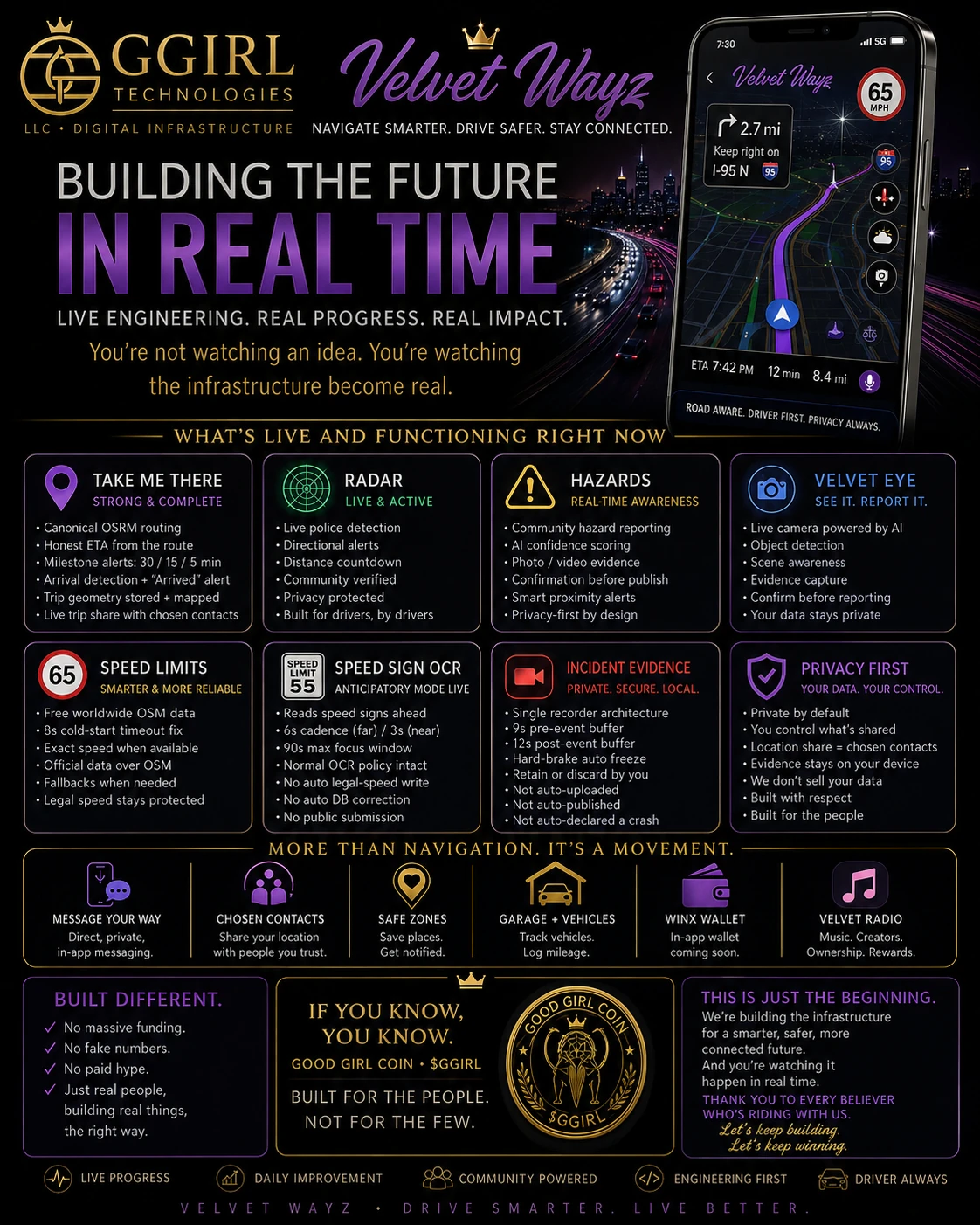
You are not watching an idea anymore. You are watching the infrastructure become real.
Velvet Wayz remains an active proof of concept—not a finished nationwide navigation service—but the build has moved well beyond mockups and promises. The public application now combines multiple server-live, public-live and phone-proven foundations while newer road-intelligence systems continue through controlled validation.
What Is Working Today
Verified foundations include Android standalone PWA operation, iPhone Home Screen installation and launch, destination and local-place search, legal speed-limit lookup, Safe Zones, account controls, profile invite/follow/presence behavior, unified awareness, continuous opt-in perception, hazard shadow observation, and one-camera Map → Eye → Map continuity.
The canonical Velvet Cortex can receive spoken questions, answer audibly, automatically rearm follow-up listening, and perform live weather, current-road, legal-speed, nearby-hazard and traffic-intelligence lookups. Navigation state and trusted legal-speed writes remain controlled by their registered authorities.
Private Incident-Evidence Foundation
The current production architecture now uses one canonical recorder for maneuver capture, manual hazard capture, Traffic Stop capture and the private incident-evidence path. A bounded video-only incident prebuffer keeps roughly nine seconds before an event and twelve seconds after it. Hard-brake events can freeze the evidence window so the system can privately classify ordinary no-incident evidence versus stronger incident candidates.
This path does not automatically declare a crash, upload incident media, publish a community hazard or write incident evidence to the database.
Anticipatory Speed-Sign Observation
When Velvet expects a speed-limit change, the existing OCR trigger can enter a bounded focus mode using the same policy engine, run counters, in-flight guard, camera frame and local recognition path. The focused cadence is six seconds farther out and three seconds inside roughly 500 meters, with a maximum focus window of 90 seconds.
The OCR path remains candidate-only. It cannot directly overwrite trusted legal speed, automatically correct the database or automatically submit a public report.
Hazard Awareness Without Automatic Reporting
The loaded production stack contains support paths for emergency vehicles, fire and shoulder/stopped/disabled vehicles alongside the broader hazard-awareness architecture. Real-road recognition accuracy for these and other hazard classes still requires calibration and proof.
Velvet is not authorized to automatically publish everything the camera sees. Human confirmation and bounded authority remain part of the design.
Proof Over Promises
This is what build in public looks like: real systems, real testing and real progress without presenting development as a finished product. The current static integrated road-test readiness gate has passed, while real-phone and real-road validation and calibration continue.
Built for the People. Not the Few.